What Was Westward Expansion?
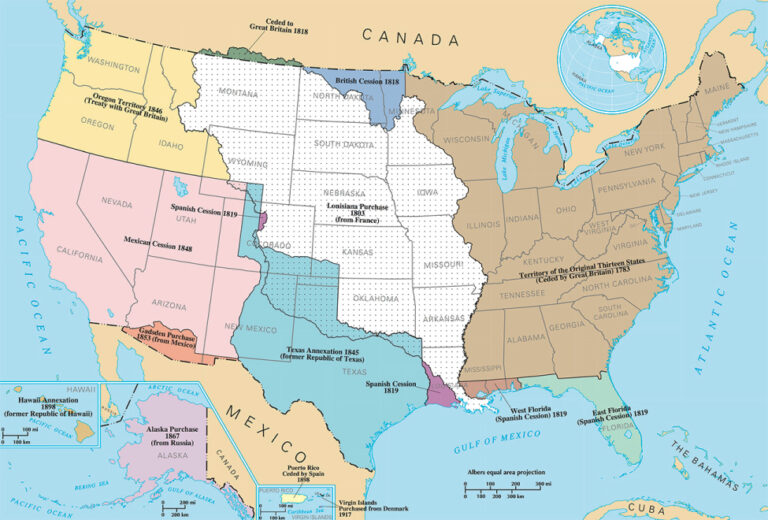
In the 1800s, many Americans believed the United States should grow across the North American continent. This movement is called Westward Expansion. Some people believed this growth was part of the nation’s Manifest Destiny, the idea that the United States had a special mission to spread its land, government, and way of life from the Atlantic Ocean to the Pacific Ocean.
What Was Manifest Destiny?
The phrase Manifest Destiny was used in 1845 by writer John L. O’Sullivan. He argued that it was America’s destiny to spread across the continent. Many Americans believed that the United States would bring freedom, democracy, and progress to new lands. Others disagreed and said this was really a form of imperialism, or taking land and power from others. Even so, the idea of Manifest Destiny became very popular.
Moving West
After the War of 1812, more Americans began moving west. They wanted land, opportunity, and a fresh start. Some were farmers looking for rich soil. Others hoped to find work, wealth, or freedom from debt. New roads, canals, and later railroads made travel easier. The Erie Canal, the National Road, and steamboats helped connect the East and the West. As transportation improved, western settlement grew quickly.
Indian Removal
Westward Expansion came at a terrible cost for Native Americans. Many Native nations already lived on the lands Americans wanted. In 1830, Congress passed the Indian Removal Act. This law allowed the government to force Native peoples east of the Mississippi River to move west. One of the most tragic examples was the Trail of Tears, when thousands of Cherokee were forced from their land. Many died from disease, hunger, and cold during the journey. Other Native groups also faced warfare, removal, and loss of land as settlers pushed westward.
Texas and the United States
Westward Expansion also involved conflict with Mexico. After Mexico gained independence from Spain in 1821, many Americans moved into Texas, which was then part of Mexico. Tensions grew between the settlers and the Mexican government. In 1836, Texas won its independence from Mexico and became the Republic of Texas. In 1845, the United States annexed Texas, making it a state. Mexico strongly opposed this action.
The Mexican American War
Disputes over Texas helped lead to the Mexican American War in 1846. The United States defeated Mexico and gained a huge amount of land in the Treaty of Guadalupe Hidalgo in 1848. This land included areas that later became California, Nevada, Utah, and parts of Arizona, New Mexico, Colorado, and Wyoming.
The war made the United States much larger, but it also increased arguments over whether slavery would spread into the new territories.
The Gold Rush
In 1848, gold was discovered in California. This began the California Gold Rush. Thousands of people rushed west hoping to become rich. These fortune seekers were called forty niners because many arrived in 1849. The Gold Rush helped California grow quickly. Towns and cities, especially San Francisco, expanded fast. But the Gold Rush also brought lawlessness, discrimination, and violence, especially against Native Americans and immigrants.
Changes in the West
As more settlers moved west, new communities formed. Families built farms, towns, and businesses. Women often worked both inside and outside the home to help their families survive. At the same time, the federal government played a larger role in building roads, supporting settlement, and organizing territories. Westward Expansion changed the map of the United States and helped create a more connected national economy.
Why It Matters
Westward Expansion shaped the future of the United States. It added huge amounts of land, encouraged settlement, and helped the country grow in power. But it also caused great suffering. Native Americans lost land, lives, and independence. Conflicts with Mexico led to war. Debates over slavery in the new territories pushed the nation closer to the Civil War. Westward Expansion is important because it shows both the growth of the United States and the human cost of that growth.
Westward Expansion: Interactive Quiz
Answer five questions based on the article. Check each answer to see an explanation.
Question 1 of 5