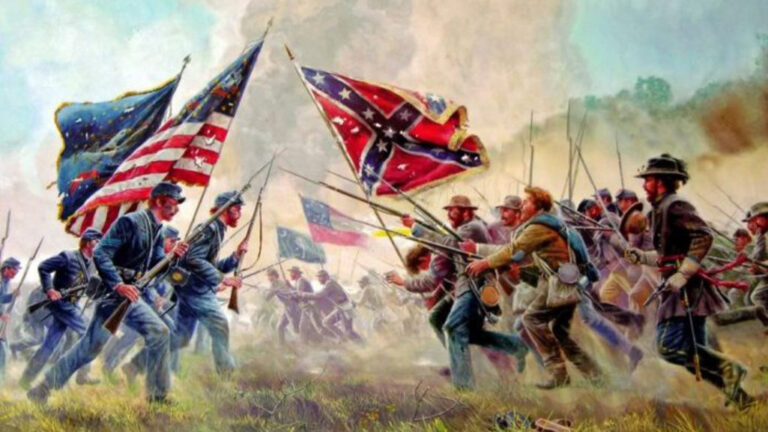
What Was the Civil War?
The Civil War was fought in the United States from 1861 to 1865. It was the bloodiest war in American history and led to the deaths of about 750,000 people. The war began as a fight to preserve the Union, but it eventually became a struggle to end slavery. It changed the country forever.
The Election of 1860
The crisis grew worse after the presidential election of 1860. The nation was deeply divided over slavery, especially over whether slavery would spread into western territories. The Democratic Party split into northern and southern groups. This division helped Abraham Lincoln, the candidate of the Republican Party, win the election. Lincoln did not call for ending slavery where it already existed, but he opposed its expansion. Many white southerners saw his victory as a threat to slavery and to their way of life.
Secession
After Lincoln’s election, several southern states decided to leave the United States. This was called secession. South Carolina seceded first in December 1860. Other southern states soon followed. These states formed a new nation called the Confederate States of America, also known as the Confederacy. The Confederacy was built on the belief that slavery should continue. Southern leaders made this clear in their speeches and official documents.
The War Begins
The war officially began in April 1861 at Fort Sumter in South Carolina. Confederate forces fired on the fort, and Union troops surrendered. After that attack, Lincoln called for soldiers to fight to save the Union. More southern states joined the Confederacy, and the country was now at war.
The Union and the Confederacy
The Union was the North. It wanted to preserve the United States as one country. The Union had more factories, more railroads, and a larger population. The Confederacy was the South. It fought to protect slavery and its independence from the Union. Many Confederate soldiers believed they were defending their homes and states. The war was long and deadly. Major battles included Bull Run, Shiloh, Antietam, Gettysburg, and Vicksburg.
From Union to Emancipation
At first, Lincoln focused on saving the Union. But as the war continued, the issue of slavery became more central. Many enslaved African Americans escaped to Union lines, forcing the government to deal with slavery directly. Their actions helped push the war toward emancipation, or freedom from slavery. After the Battle of Antietam in 1862, Lincoln issued the Emancipation Proclamation. It took effect on January 1, 1863.
The proclamation declared that enslaved people in areas rebelling against the Union were free. It did not end slavery everywhere at once, but it changed the purpose of the war and made freedom a Union goal.
African American Soldiers
After the Emancipation Proclamation, many African American men joined the Union army and navy. More than 180,000 Black soldiers served during the war. They fought bravely, even though they often faced discrimination, lower pay, and dangerous treatment if captured. Their service strengthened the Union and helped prove that African Americans deserved freedom and citizenship.
Women in the War
Women also played major roles during the Civil War. They worked as nurses, spies, fundraisers, and organizers. Many also kept farms and families running while men were away at war. Women in both the North and the South faced hardship, loss, and new responsibilities.
Major Turning Points
Two of the most important Union victories came in 1863. At the Battle of Gettysburg, Union forces stopped Confederate General Robert E. Lee from invading the North. It was one of the bloodiest battles of the war. At Vicksburg, Union General Ulysses S. Grant captured a key Confederate city on the Mississippi River. This gave the Union control of the river and split the Confederacy in two. These victories helped turn the war in the Union’s favor.
The War Ends
In 1864 and 1865, the Union used a harsher strategy called hard war. Union generals like William Tecumseh Sherman destroyed railroads, crops, and supplies in the South. At the same time, Grant kept pressure on Lee’s army in Virginia. On April 9, 1865, General Robert E. Lee surrendered to General Ulysses S. Grant at Appomattox Court House in Virginia. This effectively ended the Civil War.
The End of Slavery
During the war, Congress passed the Thirteenth Amendment, which ended slavery in the United States. It was ratified in 1865. This was one of the most important results of the war. However, the end of slavery did not end racism or inequality. Freed African Americans still faced violence, discrimination, and unfair treatment.
Why It Matters
The Civil War was one of the most important events in American history. It decided that the United States would remain one nation and it ended slavery. It also changed the meaning of freedom in America. The war showed that the nation’s greatest ideas, such as liberty and equality, were worth fighting for, but also that those ideals were not yet fully shared by everyone. The Civil War matters because it reshaped the United States and left questions about freedom, equality, and justice that continued long after the fighting ended.
American Civil War: Interactive Quiz
Answer five questions based on the article. Check each answer to see an explanation.
Question 1 of 5