World War II was the deadliest war in human history. It lasted from 1939 to 1945 and involved countries from across the world. About 80 million people died during the war.
The war caused destruction on a massive scale. It included the Holocaust, the use of atomic bombs, and major fighting in Europe, Africa, and the Pacific. When the war ended, the United States emerged as the world’s strongest power.
How Did the War Begin?
The roots of World War II began in the years after World War I. In Germany, anger over the harsh Treaty of Versailles, economic problems, and political instability helped Adolf Hitler and the Nazi Party rise to power.
Hitler rebuilt Germany’s military and began taking over nearby lands. In 1939, Germany invaded Poland. This caused Great Britain and France to declare war, beginning World War II in Europe.
In Asia, Japan had already been expanding. In 1931, Japan invaded Manchuria in China. In 1937, Japan launched a larger war against China and committed terrible acts of violence, including the Rape of Nanjing.
The United States and the War
At first, many Americans wanted to stay out of the war. This idea was called isolationism.
But that changed on December 7, 1941, when Japan attacked the U S naval base at Pearl Harbor, Hawaii. The next day, the United States declared war on Japan. Soon after, Germany and Italy declared war on the United States.
America was now fully involved in World War II.
Fighting in Europe
In Europe, the United States joined the Allies, including Great Britain and the Soviet Union, to fight the Axis Powers, especially Germany and Italy.
Major events in the European war included:
- The Battle of Britain
- Germany’s invasion of the Soviet Union
- The D Day invasion of Normandy in 1944
- The final defeat of Germany in 1945
The Allies slowly pushed Germany back. In May 1945, Germany surrendered. This became known as V-E Day, or Victory in Europe Day.
Fighting in the Pacific
In the Pacific, the United States fought Japan across many islands and ocean regions.
The U S used a strategy called island hopping, capturing islands that could help them move closer to Japan.
Important battles included:
- Midway
- Guadalcanal
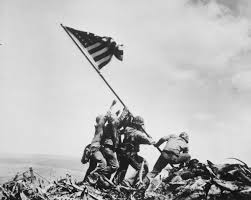
- Iwo Jima
- Okinawa
Fighting in the Pacific was especially brutal. Both sides suffered heavy losses.
The Holocaust
One of the worst crimes of World War II was the Holocaust. Under Hitler’s rule, the Nazis murdered about 6 million Jews and millions of other people they considered undesirable.
These victims included Roma, people with disabilities, political prisoners, and others. Many were killed in concentration camps and death camps.
The Holocaust remains one of the clearest examples of hatred and genocide in history.
The Home Front
World War II changed life in the United States. Factories switched to making weapons, vehicles, and supplies for the war. This helped end the Great Depression.
Women entered the workforce in large numbers, symbolized by Rosie the Riveter. Many also served in military support roles.
African Americans served in the military and worked in defense industries, while also pushing for greater equality at home. This effort became known as the Double V Campaign, victory against fascism abroad and racism at home.
At the same time, fear and prejudice led to injustice. The U S government forced over 110,000 Japanese Americans into internment camps, even though most were American citizens.
The War Ends
In Europe, the war ended in May 1945. But the war in the Pacific continued.
In August 1945, the United States dropped atomic bombs on Hiroshima and Nagasaki in Japan. Soon after, Japan surrendered.
The formal surrender took place on September 2, 1945. World War II was finally over.
Why It Matters
World War II changed the world. It ended the rule of Nazi Germany and Imperial Japan, exposed the horrors of the Holocaust, and introduced the world to nuclear weapons.
The war also made the United States a global superpower. At home, it changed the economy, expanded opportunities for some groups, and exposed deep unfairness toward others.
World War II matters because it shaped the modern world and raised important questions about freedom, power, equality, and human rights.
World War II: Interactive Quiz
Answer five questions based on the article. Check each answer to see an explanation.
Question 1 of 5