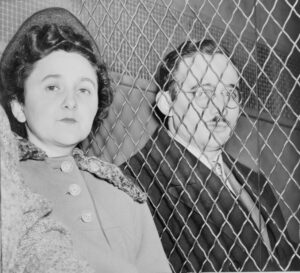
Who Were the Rosenbergs?
During the Second Red Scare, Americans feared that communist spies were secretly working inside the United States. One of the most famous and controversial cases involved Julius and Ethel Rosenberg.
The Accusation
Julius Rosenberg had worked at a U S Army laboratory during World War II, where he had access to classified information. In 1950, he and his wife Ethel Rosenberg were arrested.
They were accused of passing atomic bomb secrets to the Soviet Union, America’s main rival during the Cold War. This was a serious charge because nuclear weapons were extremely powerful and important for national security.
Both Julius and Ethel had been connected to the Communist Party in the past, which made the accusations seem more believable to many Americans.
The Trial
The Rosenbergs were put on trial in 1951. A key witness was David Greenglass, Ethel’s brother. He testified that Julius had asked him to share secret information about the atomic bomb, and that Ethel had helped type the notes.
The Rosenbergs denied all charges. They said they were innocent and that the accusations were false.
Even so, the jury found them guilty of espionage, which means spying for another country.
The Execution
On June 19, 1953, Julius and Ethel Rosenberg were executed. They became the first American civilians executed for espionage during the Cold War. Their execution shocked the nation and the world.
Some people believed they were guilty and deserved punishment. Others believed the trial was unfair or that the punishment was too harsh, especially for Ethel.
An Anticommunist Frenzy
The Rosenberg case helped fuel an anticommunist frenzy. This means that fear of communism spread rapidly, causing people to become suspicious and to believe that enemies were hiding everywhere. Many Americans became convinced that Soviet spies had infiltrated the United States. This fear allowed leaders like Joseph McCarthy to make claims about communist influence and gain attention.
Fear and Suspicion
Because of cases like the Rosenbergs, people across the country began to fear being accused. Even small connections to communism could ruin a person’s career or reputation. This fear affected everyday life. People were pressured to show patriotism and avoid anything that might seem suspicious.
Why It Matters
The Rosenberg case became one of the most important events of the Second Red Scare. It showed how serious the United States government was about stopping communism. At the same time, it raised important questions about fair trials, evidence, and justice. Many people still debate whether the Rosenbergs received a fair trial. This case helps us understand how fear can shape decisions during times of conflict. It reminds us to think carefully about fairness and rights, even during dangerous times.