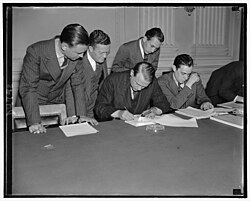
During the Second Red Scare, many Americans feared that communists had secretly entered the United States government and society. One group created to investigate these fears was the House Un-American Activities Committee (HUAC).
HUAC played a major role in spreading fear and suspicion during the Cold War.
The Rise of Anticommunism
After World War II, fear of communism grew quickly. In 1947, President Harry S. Truman issued a loyalty order that required government workers to prove they were loyal to the United States.
At the same time, Congress increased investigations. Committees like HUAC and the Senate Permanent Subcommittee on Investigations (SPSI) held hearings to search for communist influence.
Between 1949 and 1954, over one hundred investigations took place. Teachers, government workers, and others were questioned. Some lost their jobs for refusing to sign loyalty oaths.
This period created an anticommunist frenzy, which means a time of intense fear when people become suspicious, make accusations without strong evidence, and believe threats are everywhere.
The Role of HUAC
The House Un-American Activities Committee (HUAC) was first created in 1938, but it became much more powerful after World War II.
Its job was to investigate people suspected of being disloyal or connected to communism. HUAC held public hearings where witnesses were questioned about their beliefs and actions.
Many Americans supported HUAC because they believed it protected the country. Others believed it went too far and violated people’s rights.
Famous Cases and Investigations
HUAC investigated several important cases. One was Alger Hiss, a former government official accused of being part of a Soviet spy network. In 1948, Whittaker Chambers testified that Hiss had worked in a secret communist group. Hiss denied the charges but was later convicted of perjury.
Another major case involved Julius and Ethel Rosenberg, who were accused of passing atomic bomb secrets to the Soviet Union. They were found guilty and executed in 1953.
These cases made many Americans believe that communists had infiltrated the government. Fear spread quickly across the country.
McCarthyism and Fear
Fear of communism also helped Joseph McCarthy rise to power. In 1950, he claimed he had a list of communists working in the government, even though he had no real proof.
His actions became known as McCarthyism, a period when people were accused of being communists without strong evidence.
HUAC and McCarthy both contributed to a growing sense of fear and suspicion in American society.
HUAC and Hollywood
In 1947, HUAC began investigating Hollywood. The committee believed that movies might be spreading communist ideas.
Actors, writers, and directors were called to testify. They were often asked, “Are you now, or have you ever been, a member of the Communist Party?”
Some refused to answer. A group known as the Hollywood Ten was sent to jail for refusing to cooperate.
Many others were blacklisted, meaning they could not find work in the film industry.
A Culture of Fear
The work of HUAC helped create a culture of fear. People worried about being accused. Even small connections to communism could damage a person’s life.
Many people felt pressure to show patriotism, support capitalism, and follow accepted beliefs. Those who did not could be seen as suspicious.
This time has been called an “age of anxiety” because fear affected everyday life.
Why It Matters
The House Un-American Activities Committee (HUAC) played a major role in the Second Red Scare. It helped spread fear and led to many investigations and accusations.
While some real spies were discovered, many innocent people were also harmed. They lost jobs, reputations, and opportunities.
HUAC reminds us how fear can affect a country’s actions. It shows the importance of protecting freedom of speech, fair trials, and individual rights, even during times of danger.
HUAC: Interactive Quiz
Answer five questions based on the article. Check each answer to see an explanation.
Question 1 of 5