Who Was Alger Hiss?
During the Second Red Scare, many Americans feared that communists had secretly entered the United States government. One of the most important and shocking cases involved Alger Hiss.
A Government Official
Alger Hiss was one of the highest ranking officials ever accused of spying for the Soviet Union. He worked in the U.S. State Department and helped shape American foreign policy.
He also served as secretary general of the United Nations Charter Conference in 1945, where world leaders met to create the United Nations. After leaving the government in 1946, he remained a respected public figure.
Because of his high position, the accusations against him shocked the country.
The Accusation
In 1948, a former communist named Whittaker Chambers accused Hiss of being part of a secret Soviet spy network. Chambers testified before the House Un American Activities Committee (HUAC).
He claimed that he and Hiss had worked together in a “communist underground”, a secret group that supported communism inside the United States during the 1930s.
A young congressman named Richard Nixon, who was part of HUAC, strongly supported the investigation and helped bring national attention to the case.
Hiss denied all the accusations. He said he was innocent and had never been a spy.
The Evidence
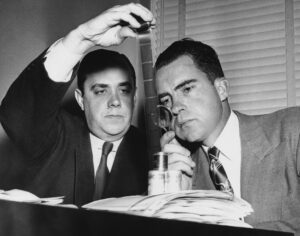
During the investigation, Chambers produced documents that he said Hiss had given him. These became known as the “Pumpkin Papers”.
The Pumpkin Papers included typed government documents and microfilm, which is a small photographic film used to store secret information. Chambers said he hid this evidence inside a pumpkin on his farm.
The story of hidden documents inside a pumpkin captured the public’s attention. Many Americans believed this proved that spying had taken place, even though the case was still debated.
The case quickly became national news.
The Trial
Alger Hiss went to trial, but the first trial in 1949 ended with a hung jury, meaning the jurors could not agree.
In a second trial in 1950, he was found guilty of perjury, which means lying under oath. He was not charged with espionage because too much time had passed under the law.
He was sent to prison.
Although he was not convicted of spying, many Americans believed he had been involved in espionage.
An Anticommunist Frenzy
The Hiss case helped create what is called an anticommunist frenzy. An anticommunist frenzy is a time when fear of communism spreads quickly, causing people to become suspicious, accuse others without strong evidence, and believe that enemies are everywhere.
After Hiss’s conviction, many Americans began to believe that communists had secretly entered the highest levels of government. Fear spread across the country.
Why It Matters
The Alger Hiss case played a major role in the Second Red Scare. It made many Americans believe that communism was a serious threat inside their own government.
The case also helped political leaders like Richard Nixon gain national attention and power.
Most importantly, it shows how fear and suspicion can influence public opinion. It reminds us that during times of fear, it is important to carefully examine evidence and protect fairness and justice.