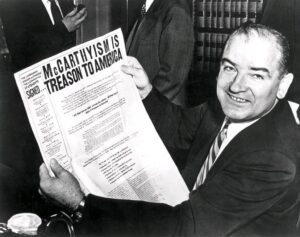
A Red Scare is a time when people have a strong fear of communism and believe it is a threat to their country. In the United States, there were two major Red Scares.
The first began after World War I, when Americans feared anarchists, immigrants, and radical political ideas. Decades later, during the Cold War, a new wave of fear spread across the country. This period became known as the Second Red Scare, when people worried that communists had secretly entered the United States government and society. One of the most famous figures of this time was Senator Joseph McCarthy.
McCarthy’s Rise
On February 9, 1950, McCarthy gave a speech in West Virginia. He claimed he had a list of over 200 communists working in the U S government. He waved a piece of paper as proof. However, McCarthy never showed real evidence. The number of names he claimed kept changing. Even so, his accusations made him famous and increased fear across the country. This period of fear and accusations became known as McCarthyism.
Fear Spreads Across the Nation
Fear of communism had already been growing. In 1947, President Harry S. Truman created a program to check the loyalty of government workers. Thousands of employees were investigated. Congress also took action. Groups like the House Un-American Activities Committee (HUAC) held hearings to investigate suspected communists. Many people were questioned about their beliefs and actions. Some lost their jobs for refusing to answer questions or sign loyalty oaths. Teachers, government workers, and others were affected.
Famous Espionage Cases
Several major cases increased public fear. Julius and Ethel Rosenberg were accused of giving nuclear secrets to the Soviet Union. They were found guilty and executed in 1953. Another case involved Alger Hiss, a government official accused of spying. He denied the charges but was later convicted of lying under oath. These cases made many Americans believe that communists were hiding everywhere.
McCarthy’s Investigations
McCarthy continued making accusations against government officials, the military, and others. Many people feared being accused, even without proof. In the entertainment industry, actors and writers were investigated. Some refused to answer questions and were blacklisted, meaning they could no longer find work. People were often asked, “Are you now, or have you ever been, a member of the Communist Party?”
Fall of McCarthy
Over time, more people began to question McCarthy’s actions, especially after he began accusing the U.S. Army of being “soft” on communism. A Senate investigation found his claims were false. In 1954, televised hearings showed McCarthy aggressively questioning witnesses. Many Americans turned against him after seeing his behavior. Later that year, the Senate voted to censure McCarthy, officially condemning his actions. His influence quickly faded. He died three years later.
A Culture of Fear
The Second Red Scare affected everyday life. Americans were expected to show strong patriotism, support capitalism, and often express religious belief, reflecting what historian Arthur Schlesinger described as an “age of anxiety” shaped by fears of nuclear war and global totalitarianism. People who were seen as different or “un-American” could be targeted. This included activists, artists, and even ordinary citizens.
Why It Matters
The Second Red Scare shows how fear can influence a country’s actions. Many people were accused without evidence and lost their jobs, reputations, or freedom. It also reminds us of the importance of protecting rights like free speech and fair trials. Even during times of danger, these rights are essential. McCarthyism had lasting effects on American politics and society. It shaped how Americans think about security, freedom, and fear during times of conflict.