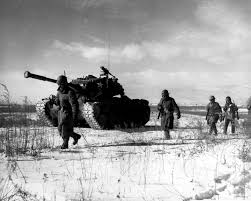
The Korean War was one of the first major conflicts of the Cold War. Even though the fighting happened in Asia, it was part of a larger struggle between communism and democracy. The war began in 1950 and involved many countries and millions of people.
Before the Korean War
To understand the Korean War, it helps to look at World War II. Before the war ended, Korea had been controlled by Japan. When Japan surrendered in 1945, Korea was freed. However, instead of becoming one united country, Korea was divided at the 38th parallel.
- North Korea became a communist nation supported by the Soviet Union. Its leader was Kim Il sung.
- South Korea became an anti communist republic supported by the United States. Its leader was Syngman Rhee.
Both sides wanted to reunite Korea, but each wanted to do it under their own system. Tension rose as they built separate governments and armies.
North Korea Attacks
On June 25, 1950, North Korean soldiers crossed the 38th parallel and invaded South Korea. Kim Il sung hoped to unite the country under communism. The United States and the United Nations (UN) viewed this as an act of aggression and quickly chose to support South Korea.
The United States Responds
President Harry S. Truman believed in a policy called containment, which meant preventing communism from spreading. He sent U S forces to help the UN defend South Korea.
The main U S commander was General Douglas MacArthur, a well known World War II hero. At first, things went badly. The North Korean army pushed South Korean and UN forces back to a small corner of the peninsula called the Pusan Perimeter.
MacArthur then planned a bold surprise attack. In September 1950, he landed troops at Inchon, a port city on the west coast. The landing was a major success. UN and U S forces pushed the North Korean army back, advancing close to the border with China.
China Enters the War
China worried about having U S troops so close to its border. In November 1950, hundreds of thousands of Chinese soldiers entered the war on North Korea’s side. The fighting shifted again, and both sides gained and lost ground without winning a final victory.
MacArthur wanted to attack China directly and even suggested using nuclear weapons. President Truman refused because he feared this might start World War III. The disagreement grew so serious that in April 1951, Truman removed MacArthur from his command. This was a major moment in U S history because no president had ever dismissed such a popular general.
A Stalemate and Ceasefire
By 1951, the war settled into a stalemate, meaning neither side could make major progress. Peace talks began, but they lasted for two years because both sides argued over issues like prisoner of war (POW) exchanges.
In 1953, the two sides agreed to a ceasefire. A Demilitarized Zone (DMZ) was created near the 38th parallel to separate North and South Korea. A peace treaty was never signed, so technically the two countries are still at war today.
Why It Matters
The Korean War showed that the United States was willing to fight to stop the spread of communism. It also proved that Cold War tensions could lead to smaller but deadly wars.
More than 36,000 American soldiers died, and total deaths from all countries likely reached several million. The war left Korea divided, and the DMZ remains one of the most heavily guarded borders in the world.
The Korean War: Interactive Quiz
Answer five questions based on the article. Check each answer to see an explanation.
Question 1 of 5