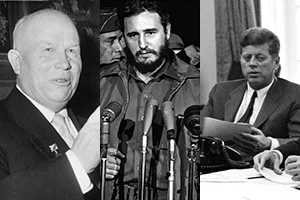
The Cuban Missile Crisis: The World on the Brink
The Cuban Missile Crisis was the closest the world ever came to nuclear war during the Cold War. It happened in October 1962 and lasted for 13 tense days. During this time, the United States and the Soviet Union stood on the edge of disaster over missiles in Cuba.
Missiles in Cuba
In 1962, American spy planes discovered that the Soviet Union was secretly placing nuclear missiles in Cuba. These missiles could reach the United States in just a few minutes. The U.S. saw this as a major danger to national safety.
A year earlier, the Bay of Pigs invasion had failed. During that attack, the U.S. tried to help Cuban exiles overthrow Fidel Castro. After this failure, Castro feared another invasion. He turned to the Soviet Union for protection.
Nikita Khrushchev, the Soviet leader, placed the missiles in Cuba to protect Castro. He also wanted to respond to U.S. missiles that were already in Turkey near the Soviet border.
President Kennedy Takes Action
When U.S. President John F. Kennedy learned about the missiles, he had to act quickly. Instead of attacking Cuba, he decided to blockade the island. This meant that the U.S. Navy would stop all Soviet ships from bringing more weapons into Cuba.
Kennedy warned that if any missile was launched from Cuba, the U.S. would see it as an attack by the Soviet Union—and would strike back.
Thirteen Days of Tension
For almost two weeks, the world waited to see what would happen. People were afraid of a nuclear war that could destroy cities and kill millions. The U.S. and Soviet Union exchanged messages, trying to find a peaceful solution.
Finally, Khrushchev agreed to remove the missiles from Cuba, and in return, the U.S. promised not to invade Cuba. Secretly, the U.S. also agreed to remove its missiles from Turkey.
Why It Matters
The Cuban Missile Crisis is one of the most important events of the Cold War. It showed how dangerous the arms race had become and how close the world came to nuclear war. Afterward, both countries worked to improve communication. They even set up a “hotline” between the U.S. and Soviet leaders to prevent future crises.
This event taught the world an important lesson: in a nuclear age, talking and negotiating can be the difference between peace and war.