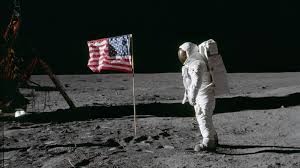
The Space Race was an important part of the Cold War, which lasted from about 1947 to 1991. It was a competition between the United States and the Soviet Union to achieve major successes in space exploration. Each country wanted to prove that its science, technology, and political system were superior.
Why the Space Race Began
After World War II ended in 1945, both the United States and the Soviet Union worked to develop new technologies. Rockets were originally designed as weapons during the war, especially in the 1940s, but scientists soon realized they could be used to explore space.
When the Cold War began in the late 1940s, space became another area of competition. Success in space showed technological power and national pride.
Sputnik and the First Successes
In 1957, the Soviet Union launched Sputnik, the first artificial satellite to orbit Earth. This shocked the United States and worried many Americans. People feared the Soviet Union was ahead in science and missile technology.
The Soviet Union continued to lead early in the Space Race. In 1961, Soviet astronaut Yuri Gagarin became the first human to travel into space. In 1965, another Soviet astronaut, Alexei Leonov, performed the first spacewalk.
The United States Responds
The United States quickly increased its space efforts. In 1958, it created NASA, the National Aeronautics and Space Administration. The goal of NASA was to explore space and catch up to the Soviet Union.
In 1961, President John F. Kennedy challenged the nation to land a man on the Moon and return him safely to Earth before the end of the decade. This became a major national goal.
The Moon Landing
In 1968, the Apollo 8 mission became the first to orbit the Moon. On July 20, 1969, American astronaut Neil Armstrong became the first person to walk on the Moon during the Apollo 11 mission. His achievement was watched by millions of people around the world.
The Moon landing was a major victory for the United States in the Space Race. It showed that the U S had caught up to and surpassed the Soviet Union in space exploration.
Why It Matters
The Space Race led to many scientific and technological advances during the 1950s and 1960s. Satellites improved communication, weather forecasting, and navigation.
It also showed that the Cold War was not only about weapons and armies but also about innovation and exploration. In 1975, the Apollo Soyuz Test Project symbolized cooperation between the United States and the Soviet Union. The Space Race inspired future space missions and continues to influence science and technology today.