The Berlin Airlift: A Cold War Victory Without Fighting
After World War II, the world’s superpowers—the United States and the Soviet Union—became enemies in a conflict called the Cold War. Although they never fought directly, they competed for power and influence around the world. The U.S. believed in democracy, a system where people vote for their leaders and have basic rights and freedoms. The Soviet Union believed in communism, where the government controls most things and makes decisions for the people. One of the first big battles of the Cold War was the Berlin Airlift—but it didn’t involve bombs or guns. Instead, it was a peaceful way to help people survive.
Dividing Germany and Berlin
After World War II, Germany was divided into four zones controlled by the U.S., Britain, France, and the Soviet Union. Even though Berlin was located deep inside the Soviet zone, the city itself was also divided into four sections, with each country controlling a part. Over time, the U.S., Britain, and France combined their zones in Berlin to form West Berlin, which became a democratic area. The Soviet Union controlled East Berlin, which was communist. By 1948, the Western Allies wanted to rebuild their parts of Germany and Berlin into a strong democracy, but the Soviet Union opposed this and wanted to keep all of Berlin under its control.
The Berlin Blockade
In June 1948, the Soviet Union decided to block all roads, railways, and canals going into West Berlin, the part controlled by the U.S., Britain, and France. This action was called the Berlin Blockade. Their goal was to force the Allies out of Berlin by cutting off food, fuel, and other supplies to over 2 million people living in West Berlin.
America and Its Allies Take Action
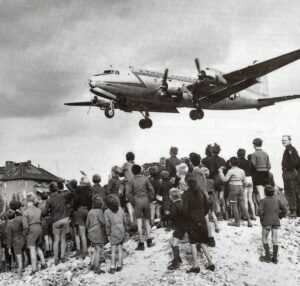
Instead of giving up West Berlin, the United States and its allies came up with a bold idea: fly supplies into the city. This plan became known as the Berlin Airlift.
Every day, hundreds of planes flew into Berlin carrying food, medicine, coal, and other supplies. At one point, planes were landing every 30 seconds! Over the next 11 months, the U.S. and its allies delivered more than 2.3 million tons of goods to the people of West Berlin.
One pilot, nicknamed the “Candy Bomber,” even dropped candy attached to little parachutes for the children of Berlin, showing how even small acts of kindness could bring hope.
The Blockade Ends
The Soviet Union soon realized that the airlift was working and that the people of West Berlin would not give in. On May 12, 1949, the Soviets ended the blockade. The Berlin Airlift was a major victory for the Allies and a powerful example of standing up to communism without using force.
Why It Matters
The Berlin Airlift showed that the U.S. and its allies were willing to protect freedom and democracy, even without going to war. It also marked the beginning of the Cold War struggle between the free world and the communist world. The airlift proved that unity, determination, and peaceful actions could defeat aggression.