The Vietnam War: A Story of a Nation Divided
When people look back at the Vietnam War, they often remember how confusing and emotional the time felt. For many, it seemed like the world was being pulled in two directions. The United States and the Soviet Union were competing for influence during the Cold War, and Vietnam became one of the places where this struggle turned violent. The conflict was not just a battle of armies. It was also a battle of ideas, fears, and hopes for the future.
Two Vietnams, Two Different Paths
After World War II, Vietnam was ready for independence after years of French control. A leader named Ho Chi Minh dreamed of a united country where all Vietnamese people could live freely. When his fighters defeated the French in 1954, it seemed like that dream might come true. But instead of becoming one nation, Vietnam was split at the 17th parallel.
In the north, Ho Chi Minh created a government built on communism.
In the south, Ngo Dinh Diem rose to power with strong support from the United States.
An election was supposed to bring the country together, but it never happened. People all across Vietnam began to sense that the disagreement between north and south was turning into something far more dangerous.
A New Kind of Resistance
Many families living in South Vietnam were unhappy with Diem’s leadership. Some felt ignored, others felt mistreated, and many were frustrated. Slowly, small groups began to organize in secret. These groups joined together to form the National Liberation Front, whose fighters became known as the Viet Cong.
The Viet Cong did not have more soldiers or bigger weapons than the South Vietnamese army. Instead, they relied on guerilla warfare. They hid in jungles, traveled through underground tunnels, and launched surprise attacks before disappearing again. They blended in with ordinary people, which made it difficult for American and South Vietnamese soldiers to know who the enemy was.
What began as political frustration had now turned into a full resistance movement.
Why the United States Entered the Fight
Far from Vietnam, American leaders watched the situation with growing worry. They believed in containment, the idea that communism needed to be stopped before it spread. They feared something called the Domino Theory. If Vietnam became communist, they thought other Asian countries might follow.
At first, the United States sent advisers to help South Vietnam. But in 1964, an event known as the Gulf of Tonkin Incident changed everything. Soon after, President Lyndon B Johnson received permission from Congress to send full combat troops into Vietnam.
This turned the conflict into a proxy war. North Vietnam received help from communist countries like the Soviet Union and China. South Vietnam received help from the United States. The two superpowers never fought each other directly, but their competition fueled the violence in Vietnam.
War in the Jungle
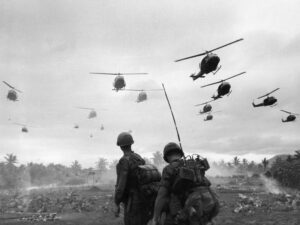
American troops arrived and quickly realized that this was not a traditional war. The jungle swallowed sound and sunlight. Heat hung in the air. Soldiers had to search for Viet Cong fighters who moved like shadows. Hidden traps waited on forest floors, and underground tunnels stretched for miles.
The United States launched massive bombing missions and hoped to win through attrition, wearing the enemy down. Chemicals like Agent Orange were sprayed to destroy vegetation. Large regions became free fire zones, meaning anyone still living there could be treated as the enemy. Villages emptied, families fled, and the countryside changed forever.
Still, the Viet Cong and North Vietnamese fought on.
The Tet Offensive: A Night That Changed Everything
In January 1968, during Tet, the Vietnamese New Year, many soldiers expected a quiet period. Tet was usually a time for peace and celebration.
But just before dawn, explosions shattered the calm. In more than one hundred cities and towns, including Saigon, North Vietnamese and Viet Cong forces launched a massive surprise attack known as the Tet Offensive.
The attacks shocked American soldiers. They shocked people watching the news back home. Even though the United States pushed back the offensive, it felt like a turning point. Many Americans began to wonder if the government had been honest about how the war was going. If the enemy could strike so widely and so suddenly, was victory really close at all?
Tet changed the mood of the nation. Confidence gave way to doubt.
Anger Grows in America
At home, the news from Vietnam poured into living rooms every night. People saw images of burning villages, wounded soldiers, and crying families. Many began to question why the United States was still fighting there.
Large protests spread across the country. College campuses filled with signs, chants, and marches. Some young men refused to join the military draft, becoming draft dodgers. Others gathered peacefully to call for an end to the fighting.
When the war expanded into Cambodia in 1970, protests became even stronger. At Kent State University, a demonstration ended in tragedy when National Guard soldiers fired into a crowd, killing four students. The shock of that moment made the war feel closer and more personal for millions of Americans.
The United States had entered Vietnam to contain communism, but now it felt like the war was dividing the American people themselves.
Searching for a Way Out
By 1969, President Richard Nixon took office and introduced a plan called Vietnamization. The idea was to train South Vietnamese soldiers to take over the fighting while American troops slowly returned home.
Peace talks continued for years. Finally, in 1973, the United States signed a peace agreement with North Vietnam. American soldiers left Vietnam, though fighting between the north and south continued.
Two years later, in April 1975, North Vietnamese forces entered Saigon. The city fell, marking the end of the war. Vietnam became the Socialist Republic of Vietnam.
What the War Left Behind
The Vietnam War changed many lives. American soldiers returned home carrying deep psychological trauma. Many suffered from injuries linked to chemicals like Agent Orange. Vietnamese families faced destroyed homes, burned farmland, and the loss of loved ones.
To honor those who served, the Vietnam Veterans Memorial in Washington, DC lists more than 58,000 American names. People visit every day to touch the smooth black wall, whisper a name, or leave a flower.
Remembering Vietnam Today
The Vietnam War teaches important lessons about the difficulties of guerilla fighting, the dangers of proxy conflicts, and the importance of understanding other countries before entering war. The story of Vietnam is a reminder that battles are not only fought on the ground, but also in the minds and hearts of people on both sides.