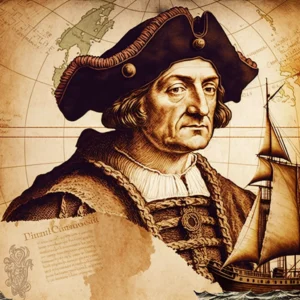
In the late 1400s, European countries wanted new trade routes to Asia. Spices, silk, and other goods were expensive. Spain hoped to find a faster way to reach Asia by sailing west across the Atlantic Ocean.
An Italian sailor named Christopher Columbus believed he could reach Asia by sailing west. He miscalculated the size of the Earth. He thought Asia was much closer than it really was. Many leaders refused to support him. Finally, King Ferdinand and Queen Isabella of Spain agreed to fund his trip.
The Voyage of 1492
In August 1492, Columbus sailed with three ships: the Niña, the Pinta, and the Santa María. After about two months at sea, on October 12, 1492, his ships landed in the Caribbean, in what is now the Bahamas.
Columbus believed he had reached islands near Asia. He called the people he met “Indians” because he thought he was in the East Indies. In reality, he had reached lands already home to Indigenous peoples.
First Encounters
The people Columbus met were the Taíno, who lived in the Caribbean. They farmed, fished, and built villages. Columbus described them as peaceful and generous.
However, Columbus had come searching for gold and wealth. When he saw that some Taíno wore small gold ornaments, he became determined to find more. He left some of his men behind and returned to Spain with captured Taíno people.
Conquest and Consequences
Columbus made four voyages to the Americas. On later trips, he brought more ships and soldiers. Spain quickly began claiming land and forcing Indigenous people to work.
The Spanish set up a labor system called the encomienda, which forced Native people to work on large estates. Violence, forced labor, and harsh treatment followed.
Even more deadly were diseases. Europeans brought illnesses like smallpox and measles. Native Americans had no immunity to these diseases. Within a few generations, much of the Indigenous population of the Caribbean had died. Some historians estimate that up to 90 percent of Native Americans in the Americas died within the first century after contact.
Why It Matters
Christopher Columbus did not “discover” an empty land. Millions of people were already living in the Americas. But his voyage in 1492 connected Europe and the Americas permanently.
His journey began a period of exploration, conquest, colonization, and cultural exchange. It also began centuries of conflict and suffering for Indigenous peoples. At the same time, it started global exchanges of plants, animals, goods, and ideas that reshaped the world.
Columbus’s voyage marked the beginning of a new chapter in world history. The effects of that moment are still felt today.