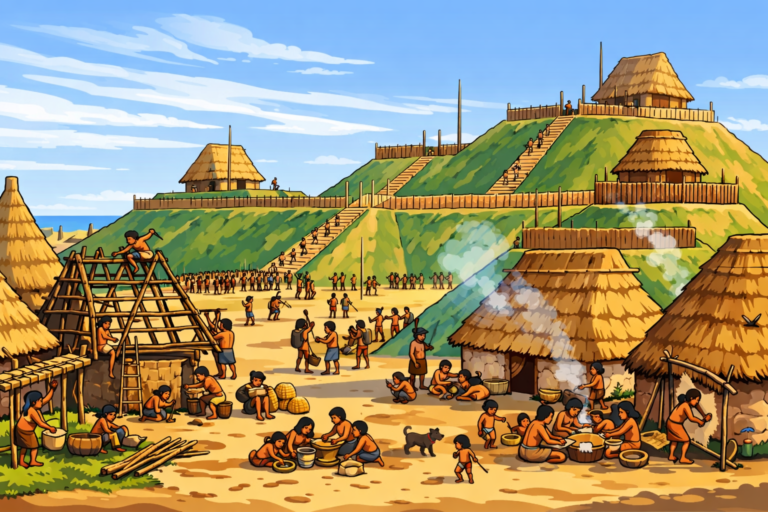
When Europeans arrived in the Americas, they called it the “New World.” But it was not new at all. Millions of people had lived there for thousands of years. They had cities, farms, trade networks, and rich cultures long before Columbus sailed across the Atlantic.
The First Americans
The first people came to the Americas between 12,000 and 20,000 years ago. During the last Ice Age, a land bridge connected Asia and North America. Small groups of hunter gatherers crossed into the continent. Over time, they spread across North and South America
These early communities adapted to many environments. Some followed buffalo on the plains. Others fished along rivers and coasts. Many later developed farming. Corn, beans, and squash, known as the Three Sisters, became important crops in many regions.
Great Civilizations and Diverse Cultures
Long before Europeans arrived, large civilizations developed. In the Southwest, the Puebloan peoples built cliff dwellings and large stone structures like those at Chaco Canyon. Along the Mississippi River, the city of Cahokia became one of the largest cities in North America, with massive earth mounds and thousands of residents
Farther south, powerful empires rose. The Aztecs built the great city of Tenochtitlán, and the Incas created a vast empire in the Andes Mountains with roads stretching for thousands of miles
Native societies were not all the same. They spoke hundreds of languages. Some lived in large cities. Others lived in small villages. Many were connected through trade networks that stretched across the continent.
European Expansion
In the late 1400s, European countries began searching for new trade routes to Asia. Advances in shipbuilding and navigation helped them travel farther than ever before
In 1492, Christopher Columbus sailed west for Spain and landed in the Caribbean. He believed he had reached Asia, but he had actually reached lands already home to Indigenous peoples
Soon, more explorers followed. Spain conquered large Native empires in Mexico and South America. Hernán Cortés defeated the Aztecs in 1521, and Francisco Pizarro conquered the Inca Empire in the 1530s.
The Columbian Exchange
The meeting of Europe, Africa, and the Americas changed the world forever. This exchange of plants, animals, people, and diseases is called the Columbian Exchange
New foods such as corn and potatoes spread to Europe and Asia. Horses and pigs were brought to the Americas. But disease had the greatest impact. Smallpox and other illnesses killed millions of Native Americans. Some historians estimate that up to 90 percent of the Indigenous population died within the first century of contact.
Why It Matters
The history of the “New World” did not begin with Columbus. It began thousands of years earlier with Indigenous peoples who built complex societies and cultures. Understanding this history helps us see that the Americas were already rich with life, trade, and knowledge before European arrival.
The meeting of these worlds changed the planet forever. It reshaped populations, economies, cultures, and even the foods we eat today. The events of this time laid the foundation for modern North and South America.